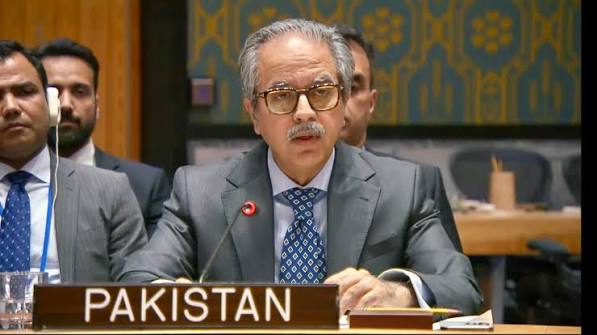


Pakistan Calls for Immediate Ceasefire and Full Respect for Lebanon’s Sovereignty
New York: Pakistan has voiced serious concern over the worsening situation in Lebanon, urging all parties to respect the country’s sovereignty and territorial integrity while calling for an immediate ceasefire and full implementation of relevant United Nations resolutions, including Israel’s complete withdrawal to the Blue Line.
The statement was delivered by Pakistan’s Permanent Representative to the United Nations, Asim Iftikhar Ahmad, during an emergency meeting of the UN Security Council focused on developments in Lebanon.
Pakistan’s remarks came amid renewed diplomatic efforts to reduce tensions in the region. Earlier, U.S. President Donald Trump stated that he had held a productive discussion with Israeli Prime Minister Benjamin Netanyahu and indicated that Israel would not deploy forces into Beirut.
Following these developments, Lebanese authorities announced a partial ceasefire arrangement between Hezbollah and Israel. According to diplomatic sources, the agreement is intended to reduce hostilities by preventing Israeli strikes on Beirut and Hezbollah-controlled suburbs, while Hezbollah would halt attacks against Israel. However, officials acknowledged that the arrangement is not expected to bring a complete end to the broader conflict.
Meanwhile, Israeli Prime Minister Benjamin Netanyahu has signaled that military operations in southern Lebanon will continue.
Addressing the Security Council, Ambassador Asim Iftikhar said that despite ceasefire arrangements and ongoing direct communication between the parties, Lebanon’s security and humanitarian conditions continue to deteriorate rapidly. He expressed concern over the expansion of Israeli military activities and reported ground incursions into Lebanese territory.
The Pakistani envoy further stated that approximately 2,000 square kilometers of Lebanese land, representing nearly one-fifth of the country’s territory, remains under Israeli control. He also criticized displacement orders that have forced civilians from their homes, describing them as a major source of suffering for affected communities.
According to Pakistan, the current situation reflects a pattern seen in other conflict zones, involving widespread violence, forced displacement, and territorial occupation.
Highlighting the humanitarian impact of the conflict, Ambassador Asim Iftikhar noted that since March, more than 3,400 people, including women and children, have reportedly lost their lives, while over 10,000 others have been injured. More than one million people have also been displaced from their homes.
Pakistan strongly condemned actions that contribute to instability and emphasized its support for all diplomatic initiatives aimed at reducing tensions and restoring peace.
Welcoming international efforts, including U.S.-led mediation initiatives, Pakistan reiterated that lasting peace can only be achieved through dialogue, diplomacy, and adherence to international law